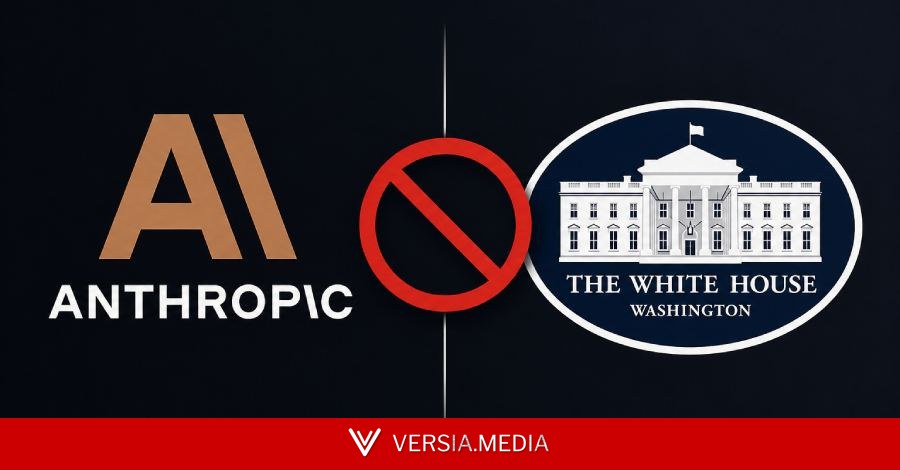
Anthropic announced on Friday that it will "abruptly disable" its most advanced artificial intelligence (AI) models, Claude Fable 5 and Mythos 5, for all users following a U.S. government directive to suspend access for foreign nationals, both inside and outside the U.S., due to national security concerns.
The AI firm stated that it received an order at 5:21 p.m. ET, requiring it to halt all access to the models for foreign nationals. It expressed that it believed a "misunderstanding" had occurred and is working to restore access as quickly as possible. The export control directive will not impact access to other models.
"Our understanding is that the government believes it has become aware of a method of bypassing, or 'jailbreaking' Fable 5," the company said.
"We reviewed a demonstration of this specific technique being used to identify a small number of previously known, minor vulnerabilities. These vulnerabilities all appear relatively simple, and we have found that other publicly-available models are able to discover them as well without requiring a bypass."
This unexpected development comes just days after the launch of Claude Fable 5 and its counterpart Mythos 5, which utilizes the same underlying model but with safeguards removed in certain areas, such as cybersecurity. The latter, described as having the "strongest cybersecurity capabilities of any model in the world," remains accessible to a curated group of cyber defenders and critical infrastructure operators.
Anthropic emphasized that it has implemented "strong" guardrails to prevent the misuse of its models for cybersecurity-related tasks. Specifically, this is supported by a set of safety classifiers designed to detect potential misuse, including jailbreak attempts, and prevent the main model from responding.
The cybersecurity classifier is intended to block harmful single-turn requests related to planning a cyber attack, exploit development, or defense evasion. The company noted that Mythos-class models are adept at finding and exploiting software vulnerabilities, thereby providing attackers with a strategic advantage.
Last week, Anthropic revealed that its Mythos-class model can convert newly disclosed software vulnerabilities into working exploits in hours, or even minutes in some cases, rather than weeks, effectively turning N-days into N-hours. These findings suggest that frontier models may be equally capable of rapidly weaponizing publicly disclosed flaws.
"A lone operator can now turn a month's worth of patches into working exploits in a single afternoon - for a few thousand dollars and with no specialized expertise," Anthropic's Red Team said. "This means that the typical patching playbook that software developers use today - with monthly release cadences, multi-week staged rollouts, and a lag between pre-release and stable channels - no longer holds."
Fable 5's protections mean that queries on cybersecurity topics will instead receive a response from Claude Opus 4.8, the company's next most capable model.
In its latest statement, the company argued that no universal jailbreak methods have been developed against the latest models to date, adding that third-party and internal red-teaming exercises have found its safeguards to be "substantially more effective than those of any previously deployed model."
Furthermore, Anthropic claimed that "the perfect jailbreak resistance" is not possible for any model provider, as every safeguard used by the industry is susceptible to non-universal jailbreaks that are "effective in very limited contexts or require additional effort to be adapted to each new situation."
"To date, the government has only given us verbal evidence of a potential narrow, non-universal jailbreak, which essentially consists of asking the model to read a specific codebase and fix any software flaws," it said.
"Our understanding is that one potential jailbreak was shared with the government. We have reviewed a report that we believe is the basis of the government's directive and validated that the level of capability displayed there is widely available from other models (including OpenAI's GPT-5.5), and is used every day by the defenders who keep systems safe."
Anthropic also pointed out that while it supports the government blocking unsafe AI deployments, it stated that the discovery of a "narrow potential jailbreak" should not be the reason for recalling a commercial model that is widely deployed. The statutory process should be "transparent, fair, clear, and grounded in technical facts," it added.
Earlier this year, the U.S. Department of Defense labeled Anthropic a "supply chain risk" after the Claude-maker sought to establish red lines regarding the military use of its technology. The company has filed two lawsuits to block this designation.
Update
Multiple reports from The Information, Reuters, and The Wall Street Journal have indicated that the export control directive leading to Anthropic cutting off access to Fable 5 and Mythos 5 for all users was partly driven by research from Amazon and concerns raised by CEO Andy Jassy with the White House.
The Journal reported that the company "used a series of prompts to get Anthropic's Fable 5 model to provide them with information that could be used to aid cyberattacks and was supposed to be off-limits."
In a post on X, David Sacks, co-chair of the U.S. President's Council of Advisors on Science and Technology, wrote that Anthropic refused to fix a jailbreak that a "highly credible trusted partner of both Anthropic and the USG [U.S. government] who was testing Fable came forward with," adding that the company "prioritized the continued offering of the consumer model over safety."
In another follow-up report published June 14, 2026, Semafor reported that the decision was motivated by fears that the model had been accessed by a group linked to China. It remains unclear how the U.S. government learned of the issue, which entity accessed the model, or how it gained access.
(The story was updated after publication to reflect the latest developments.)